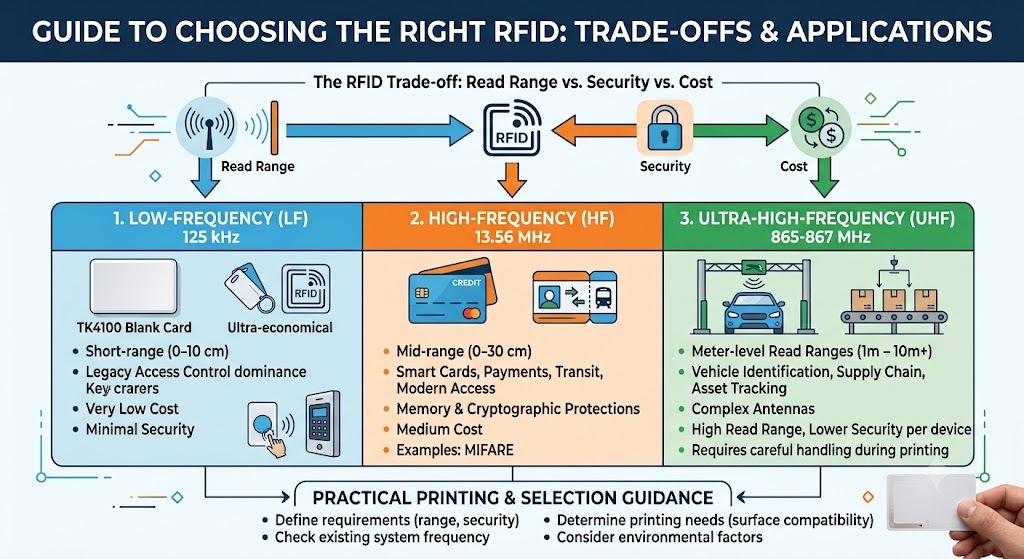
What Are RFID Cards and Tags?
RFID (Radio Frequency Identification) cards and tags are passive or active devices that store and transmit data wirelessly using radio waves. Passive tags — the most common type for cards — contain no battery and draw power from the reader's electromagnetic field. The internal chip determines the card's frequency, memory capacity, security features, and read range.
Frequency Bands at a Glance
| Frequency Band | Typical Frequency | Read Range | Primary Applications |
|---|---|---|---|
| LF (Low Frequency) | 125–134 kHz | ~10 cm | Access control, animal tagging, legacy systems |
| HF (High Frequency) | 13.56 MHz | ~1 m | Payments, transit, library, NFC |
| UHF (Ultra-High Frequency) | 865–928 MHz | 0–12 m | Vehicle ID, parking, supply chain |
Internal Chip Types by Frequency
LF (125 kHz): Common chips include TK4100, EM4100, EM4200, T5577, and HID series. Most are read-only with a fixed unique ID; T5577 offers read/write capability.
HF (13.56 MHz): MIFARE Classic, MIFARE Ultralight, and MIFARE DESFire families. These offer memory sectors, encryption, and multi-application support.
UHF (865–867 MHz): EPC Class 1 Gen 2 (ISO 18000-6C) chips such as Alien Higgs and Impinj Monza. These prioritize long-range reading and fast multi-tag identification.
Printing Considerations
Printing RFID cards requires special handling because the embedded chip and antenna create surface irregularities:
Standard thermal printers risk damage: The print head can strike the chip bump, causing white spots and permanent head damage.
Retransfer printing is the safe method for rigid RFID cards: the image prints onto a film that is then heat-bonded to the card surface, avoiding direct contact with the chip.
RFID-enabled thermal transfer printers handle flexible labels by coordinating print position with chip location for simultaneous printing and encoding.
UHF-Specific Note (865–867 MHz)
UHF cards in this band are regionally regulated (India/Europe) and typically follow EPC Gen 2 protocol. Standard CR80 cards (85.6 × 54 mm) achieve read ranges of 1–5 meters, while specialized windshield stickers can be detected at vehicle speeds up to 80 km/h.
TK4100 Blank Cards: The Budget LF Standard
📇 TK4100 Specifications
The TK4100 is the most economical entry point into 125 kHz RFID technology, designed as a direct, lower-cost equivalent to the EM4100/EM4200 series.
Chip & Memory: 64-bit read-only memory storing a unique, unchangeable serial number. Fully compatible with EM4100/EM4200 protocols — systems designed for those chips read TK4100 cards without modification.
Physical Format: Standard CR80 size (85.6 × 54 mm), thickness 0.8–0.84 mm, made from durable PVC or PET.
Performance: 125 kHz operation with a typical read range of 2–10 cm.
Surface: Plain white, printable PVC surface (glossy, matte, or frosted) with no pre-printed numbers or branding.
🖨️ Printing & "Blank" Clarification
Printer Compatibility: Compatible with standard thermal ID card printers (Zebra, Fargo, Evolis, Magicard). Retransfer printing remains safest to avoid print head damage.
Important Note on "Blank": Unlike writable chips (T5577), a TK4100 is not blank in terms of data. It is factory-programmed with a unique ID that cannot be erased or rewritten. "Blank" refers only to the visual surface, not the chip memory.
💰 TK4100 Pros & Cons
Pros:
Lowest Cost: Explicitly marketed as a cheaper alternative to EM4100 with the same performance.
Universal Compatibility: Works with any EM4100/EM4200 reader — ideal for replacing lost cards in existing systems.
Simple & Reliable: Read-only operation eliminates accidental data modification. No battery required; data retention typically 10 years.
Cons:
Minimal Security: Fixed ID is easily cloned with inexpensive tools. No encryption or authentication.
No Rewrite Capability: Cannot change the ID or store additional data.
Short Range: Read distance measured in centimeters, not meters.
🆚 TK4100 vs. EM4100
| Feature | TK4100 | EM4100 / EM4200 |
|---|---|---|
| Compatibility | Fully compatible (works on EM systems) | The original standard |
| Memory | 64-bit read-only ID | 64-bit read-only ID |
| Performance | Equivalent read range & reliability | Equivalent |
| Cost | Lower cost (key advantage) | Higher cost (original chip) |
| Adoption | Widely adopted as cost-effective substitute | Legacy standard, often more expensive |
Types: Pros, Cons, and Comparison
LF 125 kHz Cards (Including TK4100)
Pros:
Lowest cost per card
Excellent penetration through water, wood, and organic materials
Reliable in harsh industrial environments
No radio frequency licensing constraints
Cons:
Very short read range (≤10 cm)
Minimal memory (typically 64-bit ID only)
Easily cloned — major security vulnerability
Gradually being replaced by HF in access control
Best for: Legacy access control systems, animal identification, industrial tool tracking, hotel door locks, gyms, offices.
HF 13.56 MHz Cards
Pros:
Moderate read range (up to ~1 m)
Larger memory capacity (up to 128 kB)
Read/write capability for data logging
Cryptographic security options (AES, DESFire)
NFC compatibility with smartphones
Cons:
Higher cost than LF
Sensitive to metal interference
Shorter range than UHF
Best for: Payment systems, transit cards, library management, modern secure access control, NFC applications.
UHF 865–867 MHz Cards & Tags
Pros:
Longest read range (1–12 m depending on power)
Fastest data transfer and multi-tag reading
Cost-effective tags for large-scale deployment
Hands-free vehicle identification at speed
Cons:
Requires careful printing (retransfer recommended)
Historically sensitive to metal and moisture
Regional frequency regulations vary (865–867 MHz in EU/India vs. 902–928 MHz in US)
Lower market share in card form factor
Best for: Vehicle access/parking, electronic toll collection, supply chain, warehouse management, large item tracking.
Master Comparison Table
| Feature | LF 125 kHz (TK4100) | HF 13.56 MHz | UHF 865–867 MHz |
|---|---|---|---|
| Read Range | ≤10 cm | ~1 m | 1–12 m |
| Memory | 64-bit read-only ID | Moderate–Large | Moderate |
| Security | Very Low (easily cloned) | Moderate–High | Moderate–High (with SIO) |
| Metal/Moisture Tolerance | Excellent | Poor (metal), Good (moisture) | Fair–Good (improved designs) |
| Printing Method | Thermal (careful) | Retransfer recommended | Retransfer recommended |
| Cost per Card | Lowest | Moderate | Low–Moderate |
| Typical Applications | Access, animal ID | Payment, transit, NFC | Vehicle, supply chain |
Conclusion
The choice between LF, HF, and UHF RFID cards is fundamentally an application decision, not a technical one.
If you need to read a card from inches away for basic access control, LF 125 kHz — and specifically the TK4100 blank card — remains the cheapest, most compatible option. It delivers the exact same read-only ID functionality as the EM4100 at a lower price point, making it perfect for large-scale rollout (offices, gyms, hotels) or replacing lost cards in an existing EM-based system. Just remember: it is "blank" only on the surface — the chip itself is a fixed, unchangeable ID tag.
If you need payment-grade security, NFC compatibility, or modest read/write memory, HF 13.56 MHz is the standard.
If you need to identify vehicles at speed, track pallets across a warehouse, or read multiple items simultaneously from meters away, UHF 865–867 MHz is the only viable choice.
For all RFID cards with visible chips, avoid standard direct thermal printers — the physical bump will damage the print head and degrade print quality. Use retransfer technology for rigid cards and RFID-enabled thermal transfer printers for labels. The UHF 865–867 MHz band, while regionally constrained, offers unmatched range and speed for vehicle and logistics applications, provided the printing workflow respects the embedded electronics.
Final recommendation: Match the frequency to your read-range requirement, match the chip to your security requirement, and match the printer to your card type. For budget LF deployments, TK4100 blank cards are the definitive starting point.